 MeganeuraMeganeura
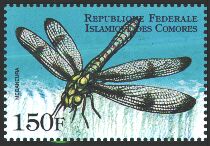
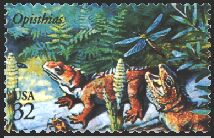
| Comoro Islands 1999 | United States of America 1997 |
 |
 |
|---|---|
| Meganeura monyi (Meganeuradae) |
Meganeuropsis americara (Meganeuradae) |
The fossil of a Odonata is discovered from early Paleozoic Permian. And the Meganeurophsis most considered to be a close relationship by the Odonata survived from the second half of Paleozoic Carboniferous period older than a Odonata to the first half of the Triassic period. Although the Odonata is resembled, neither a marginal crest nor a knot also has a triangular room in a wing. That is, wing venation is simple and the grade of specialization is low. Moreover, the abdomen is not thin like a dragonfly. Meganeuropsis americara (United States of America) of which the opened wing length is 70cm, and Meganeura monyi (France) of which the opened wing length is 75cm, famous as the greatest insect which ever appeared on the earth, is contained in this Order.
 NEXT
NEXT
 to Stamp
 to HomePage