 Insect Stamp of NamibiaInsect Stamp of Namibia
The Republic of Nambia is the last independent country of African Continent 53 countries. Indigenous people Coisanean are lived there, but a person from Europe used there from the 15th century, and Namibia was become with protection territory of a German country as South Western Africa in 1884. It was admitted into South Africa territory for 1949 years after World War I. Independent feeling rose in 1960's and finally achieved independence as the Republic of Nambia in 1990.
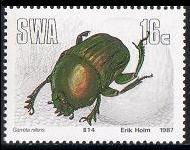
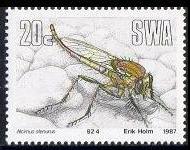
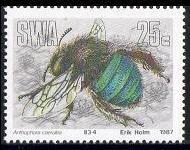
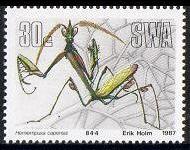
Four kinds of insect stamps were issued in 1987 by South Western Africa.
A small seat comprising five kinds of Namib Desert animal stamps and one kind of insect stamp were issued in 2000 by Republic of Nambia.
The small seat consisting of eight kinds of stamps which it drew the seven kinds of animal and one kind of insect of the Namibian central plateau on was issued in 2001.
Five kinds of animals and two kinds of class arthropoda and four kinds of plants and Cnidaria one kind are drawn on 12 kinds of stamps issued as a Namibian biological diversity stamp in 2007.
Two kinds of animals and one kind of insect and one kind of plant and microbe one kind are drawn on five kinds of stamps issued as animals and plants new discovery stamp in 2003.
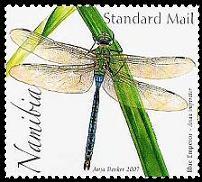
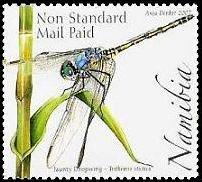
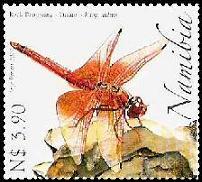
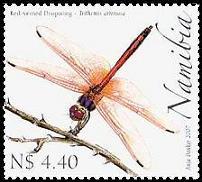
Four kinds of dragonfly stamps and small seat comprising one kind of dragonfly stamp were issued in 2007.
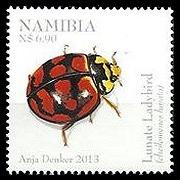
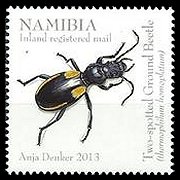
Five kinds of beetle stamps were issued in 2013.
South Western Africa
1987.5.7 Insect Stamp
 |
 |
 |
 |
|---|---|---|---|
| Green Dung Beetle Garreta nitens (Scarabaeidae) |
Robber Fly Alcimus stenurus (Asilidae) |
Carpenter Bee Anthophora caerulea (Anthophoridae) |
Giant Coneheaded Mantid Hemiempusa capensis (Mantidae) |
Repubric of Namibia
| 2000.5.22 Namib Desert Insect | 2001.9.8 Namibian Central Highland Insect | 2007.2.15 Biodiversity of Namibia |
|---|---|---|
 |
 |
 |
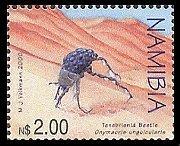
| Fog-basking Beetle Onymacris unguicularis (Tenebrionidae) |
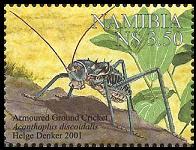
Armoured Ground Cricket Acanthoplus discoidalis (Tettigoniidae) |
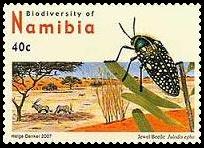
Jewel Beetle Julodis egho (Buprestidae) |
2003.2.24 New Discovery Insect Stamp
 |
|---|
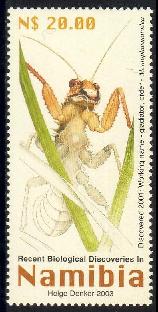
| West Wind Gladiator Mantophasma zephyra (Mantophasmatodea) |
2007.4.16 Dragonfly Stamp
 |
 |
 |
 |
|---|---|---|---|
| Emperor Dragonfly Anax imperator (Aeschnidae) |
Jaunty Dropwing Trithemis stictica (Libellulidae) |
Rock Dropwing Trithemis kirbyi ardens (Libellulidae) |
Red-veined Dropwing Trithemis arteriosa (Libellulidae) |
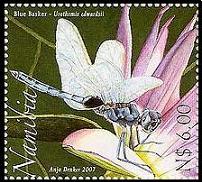 |
|---|
| Blue Basker Urothemis edwardsii (Libellulidae) |
2013.4.5 Beetles Stamp
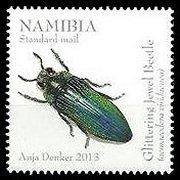 |
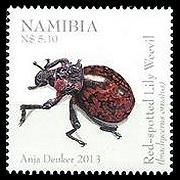 |
|---|---|
| Jewel Beetle Acamaeodera viridaenea (Buprestidae) |
Red-spotted Lily Weevil Brachycerus ornatus (Curculionidae) |
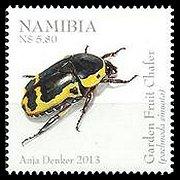 |
 |
 |
|---|---|---|
| Garden Fruit Chafer Pachnoda sinuata (Scarabaeidae) |
Lunate Ladybird Cheilomenes lunata (Coccinelidae) |
Two-spotted Ground Beetle Thermophilum homoplatum (Carabidae) |
Fog-basking Beetle is a tenebrionid living in African Namib Desert. When a friend of this beetle gets on wind from the sea, and fog flows through desert, It is busy and walk around it and it is high and lifts buttocks in a top of a wind-wrought pattern on the sands and takes proud posture standing on hand. In this way it suffer a night fog in a whole body and it gather the water which it condense dew in a surface of a body, and began to flow on a part of a mouth and take it.
As the face of the Mantophasmatodes that was discovered in 2002 year is similar to praying mantis and the body is similar to stick insect, so Latin name of a stick insect together to a mantis by resembling a stick insect and can call Mantophasmatodes. In addition, an insect put on a pick of the tip of a foot in the ground generally and walked, but Mantophasmatodes gave a tiptoe, and It was humorous, and English name West Wind Gladiator to say were touched with a heel by walking.
 NEXT
NEXT
 to Stamp
 to HomePage