A short piece on Japanese ukiyo-e prints
by woodblock printmaker David Bull
Seditious Beauty
In the early 1600's, when Ieyasu, the founder of the Tokugawa dynasty, finally achieved his dream of becoming shōgun, the grand military ruler of the country, he immediately began to set up an intricate and complex arrangement of rules designed to govern the behaviour of all inhabitants of the country. His motivation was very clear: restriction of social mobility and preservation of the status quo would preserve his (and his family’s) position as rulers of the nation for as long as possible.
From quite some time before this, Japanese society had been stratified into horizontal layers, with everybody's position on the scale made very clear. At the top was of course the figurehead of the emperor, then down through the nobility, warriors, farmers, artisans, merchants, right to the outcasts at the absolute bottom.
But as the Tokugawa era became established, this stratification now became ever more codified, and almost every possible aspect of life was regulated: what fabrics and patterns of clothing were permitted to each class, what type of house could be built, to what extent people could travel, and even what kind of daily activities were allowed.
Ieyasu's prescription for maintaining power turned out to be extremely effective. His family reigned over the country for over two and a half centuries - an enormously long time - especially when compared with the wars and chaos that disrupted European societies during the same period.
Although the concept did work well for the first hundred years or so (at least from the Tokugawa family's point of view), it was impossible to 'stop the clock' completely in actual practice, and strains gradually appeared in the structure. One major problem that developed was with the financial system. The warrior class - the samurai - had traditionally been compensated for their services in rice, rather than with actual negotiable currency. The allotment of rice they received served to support their family and retainers, and this was adequate as long as they maintained an exclusively traditional way of living.
But gradually arising in the cities, especially in Edo (old Tokyo), was a different pattern, one being led by a newly enriched merchant class, in which money played an ever-increasing role. The men of this mercantile class were poor in status, standing very low in the social hierarchy, but were increasingly rich in actual cash, obtained through their manufacturing or trading activities.

With increasing amounts of money on hand, and expanding amounts of leisure time available, it was inevitable that new forms of social activity would arise, and this period saw the development of two institutions that would help to transform large parts of society, and contribute greatly to the eventual breakup of the feudal class system. These were the kabuki theater and the 'Yoshiwara', the red-light district. Not coincidentally, the art that we now know as Ukiyo-e had a significant role to play in both of these.
Although the origins of the kabuki theater lie many years before the Tokugawa era, it could not flower until these necessary circumstances arose. It now became hugely popular, attracting not only townsmen and merchants, but also, much to the displeasure of the rulers, members of the samurai class.
Woodblock prints played an important part in the life of the theater, not just as 'advertisements' for the actors and productions, but as an integral part of the experience of visiting the theater. In an era with no television or newspapers, they performed the essential function of disseminating the theatrical experience to an audience far wider than simply those people who attended the productions.
The problem with kabuki, from the point of view of the authorities, was that the plays frequently moved into areas where the subject matter was at variance with the 'official' line, and there was constant friction between the theaters and those wishing to proscribe their activities. The woodblock prints were not excepted from these battles, and designs had to obtain the censor's approval before production.
On a far more private scale than the noisy theater, with most of its activities taking place in seclusion, the Yoshiwara was perhaps a more vital agent of social change. Sometimes referred to nowadays as the 'green houses', the brothels there provided far more than sexual services. They were places for townsmen to meet, to spend leisure time, to discuss affairs of the day, and of course to make romantic assignations.
The Edo townsmen were not meeting in such places to plot the overthrow of the government, but their pursuit of basically hedonistic activities such as poetry readings, discussions of recent novels, showing off acquisitions of new clothing or the like … these activities all served to undermine the stated goal of the regime to ‘keep everyone in his place'. And what was worse … the Yoshiwara life began to attract men from the warrior class.
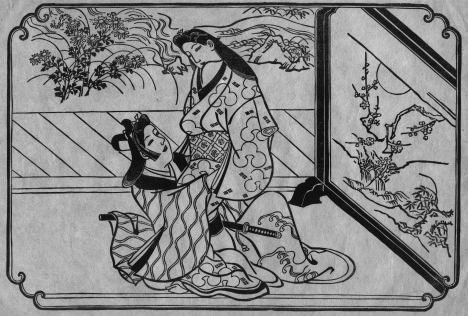
The major attraction at these places was obviously the women, and there was fierce competition between them for customers. No expense was spared when it came to clothing, hairdos, or other accessories. The fame of the women spread far and wide, and the status in society of those of the top rank can perhaps most easily be understood by comparison with someone like … a Marilyn Monroe … a kind of dream figure - unreachable and untouchable by normal men.
Only the most wealthy and favoured could ever hope to have a woman like this attend their affair in the tea house, and this was the nub of the problem for the authorities. When status in society started to be measured by the prestige of the courtesan one could buy, rather than by one's birthright and place in the hierarchy, the end of the feudal society was in sight.
Of course, for the masses at large, who could never hope to even catch a glimpse of these famous courtesans, the prints would have to suffice. They were run off in the tens of thousands, and were eagerly snapped up by the populace. The effect on society of these images was immense, just as that of top movie stars has been in our own era. Remember, there were no newspapers, no magazines, no movies … photographs ... all the power of all of our varied media were concentrated in one single outlet - woodblock prints.
 The presence of these pleasure-seeking environments - theatres and red-light districts - had a major effect in the shaping of Edo-era culture. The battle raged back and forth over the decades; the government coming out with a constant stream of regulations to try and maintain the power of the regime … what plays could be performed, what books could be published, proscribing rules about permitted colours on clothing, hairstyles … but always the townsmen found ways to express their desire for a different kind of life, looking to the ukiyo-e for guidance.
This constant stream of imagery - information about so many new and interesting things - spread so widely through every part of the population … this made it impossible to maintain the old stratification of society. When the outside world finally came knocking on Japan's door in the mid-1800's, the preparatory work had been done. That feudal society, outwardly so strong and solid, was by now hollow at the core. It collapsed in chaos, and a new society arose in its place.
It is difficult to overestimate the role that ukiyo-e played in that long process of change. The prints were everywhere. Members of a poetry circle meeting at a tea-house would have their best work carved and printed for circulation, perhaps accompanied by a design from Hokusai, who specialized in such work. The townsman's wife would eagerly peruse the latest prints in a book shop, looking for information on the latest fashions and hair styles. Vast numbers of prints and books were published, and it is hard to find any aspect of the culture of the day that was not covered.
The prints were as representative of their society as Instagram feeds are of ours now. And just as we consider a collection of celebrity Instagram photos to be anything but high art, the people of that day would never have thought of their prints as anything special. The men who created them were simple shokunin - workmen - and even the designers, who we now consider to rank among the world's greatest artists, had a social status far, far below such people as calligraphers or painters in antique Chinese styles. Ukiyo-e was not 'art', it was 'commerce'. The prints were not pretentious works, just simple honest expressions of the culture of the day, shaped by that culture, and in turn helping to shape it.
But they were a vital force for social change, as revolutionary as any political pamphlets could have been, and if they had not existed, the course of Japanese history would have been vastly different. Any single print of a beautiful courtesan could not cause the overthrow of the feudal society, but the ukiyo-e prints as a whole certainly played a major role, and that is perhaps the highest possible accolade that can be paid to any genre of art. It is certainly fitting that these prints have finally, in our time, found the respect and understanding that they did not get in their original society.
May they stand forever as symbols of the power of art to change the world.
David Bull
(The two colour illustrations accompanying this story are from my 'Surimono Albums' series of woodblock prints.)




