In which direction does
the spinal segment displace?
Last Updated; 1996.10.06
Generally, the decision for the displacement of vertebra is
based on the bone just below it. And from the 2nd cervical to
fifth lumbar, these bones could displace by rotation, tilt, or posterior.
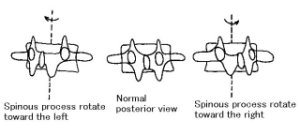
- Rotation=Left or right shift of spinous process viewed
from posterior to anterior(P-A).
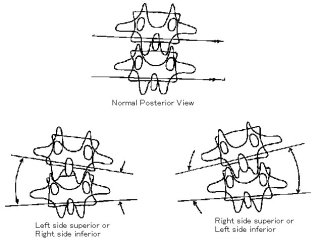
- Tilt=The difference of the height of bilateral transverse
process of vertebra viewed from P-A.
- Posterior or Anterior=Viewed from lateral
There are rules for representing these displacements,
but the explanation for these is cut off because of
its complication.
1. Rotation
2. Tilt : based on the bone just below it
3. Posterior: based on the bone just
below it
George's Line
is a line drawn down the posterior margins of vertebral bodies.
(It should drawn from body pedicle junction to body pedicle
junction without following any pathological or
hyperplastic changes on the body margins.)
Normal George's Line
should form a smooth gentle, convex anteriorly, unbroken curve, which is the anterior boundary of the neural canal and gives
indication of the integrity of the spinal canal
(below center figure).
Abnormal George's Lineis a break in the continuity of this line which is indicative of loosening of the motor unit and may result in a anterior
displacement or posterior displacement.
With anterior as well as posterior segmental displacement,
a steplike kinking of the tubelike neural canal occurs.
Consequently, the spinal cord, cauda equina, and/or membranes
are slightly too markedly encroached upon,
resulting in neurological insult and distress.
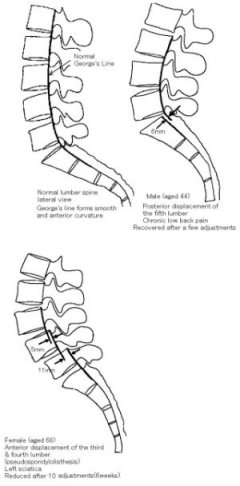
Posterior Displacement
According to the spinal facet structure, the spinal vertebral bone tends to displace toward to posterior (except first cervical bone).
See above figure, right side.
In my clinical experience, about 80% of patients complaining of
low back pain, have this posteriority somewhere in lumbar area
of the spine.
This malposition is named
RETROLISTHESIS or RETROSPONDYLOLISTHESIS,
REVERSE SPONDYLOLISTHESIS,
VERTEBRAL RETROPOSITION,
SPONDYLOLISTHESIS POSTERIOR,
RETRODISPLACEMENT
in the Roentgenographic Diagnostics.
The following literature refers to this posteriority.
*ANATOMICO-ROENTGENOGRAPHIC STUDIES OF THE SPINE
Lee A. Hadley, M.D.
Cherles C Thomas Publisher
Springfield, 1964
ISBN 0-398-02818-4, pp.390-395
*THE RADIOLOGY OF VERTEBRAL TRAUMA
Gehweiler・Osborne・Becker
W. B .Saunders Company
Philadelphia , 1980
ISBN 0-7216-4065-6 pp.445-452
This phenomenon was firstly reported in 1929 by Brailsford,
Hibbs, Swift. Accordingly, the honor of first discovery of
this phenomenon should be given to them.
However, Dr. Gonstead D.C. asserted first that these posterior
displacements can be corrected manually.
Anterior Displacement
Incidence of the anterior displacement is much lower than
the posterior displacement because of the spinal facet
structure.
This is called SPONDYLOLISTHESIS or PSEUDOSPONDYLOLISTHESIS
by medical orthopedics. See above figure.
 back to "Chiropractic in Japan" top page
Copyright 1996-; All rights reserved."Chiropractic in Japan" Maeda Shigeru,
|