Tree Planting in Ashio April 20, 1997
Ashio is a small town located about 150km north of Tokyo. It is surrounded by mountains at height ranging from 700m to 2150m, which have been formed by the River Watarase carving the geography for thousands of years. The environment is harsh, with annual temperature ranging from -15 to 34 degrees centigrade. The average rainfall is 1776mm / year. Although there is little snowfall in winter, the area is frozen with dry chilly wind for more than three months.
A copper vein was found in 1610, and especially since 1868 when Japan opened its country, mining had been accelerated to support the Japanese industry to catch up with industrialized Western countries. In the late 19th century, dead fish in the river which was contaminated with the discharged water from the refinery were observed. This was the first sign of a series of the disastrous impact. Around 1894, the latest refining method was introduced, and the valleys were filled with sulfur dioxide which was exhausted from the refurbished refinery. The results were empty valleys without any trace of life.
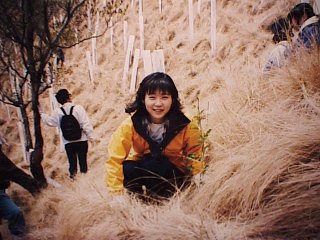
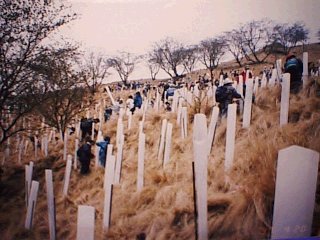
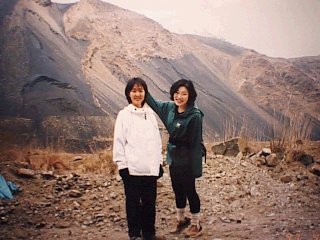
The restoration was started about 100 years ago, but its pace has become much faster since 1950's. On the day we planted trees, it was cloudy and cold, and I suppose it was around 10 degrees. As seen in the photo in the right, in which you can see my friends who joined the project with me, most mountains are bare, with stones and inorganic sandy particles sliding down on the surface with every gust of chilly wind. The slope of the mountain we planted trees had been first planted with grass 40 years before to produce soil. Thanks to the predecessors' efforts, the soil under the grass was very rich and soft, and we could plant trees easily. Unexpectedly, there were around 500 people from several conservation groups, and 1500 seedlings prepared were planted within an hour. As we had nothing more to do after finishing planting, we had early lunch and enjoyed hot miso-soup prepared by a backup group of volunteers. One of the reasons why we finished so quickly must have been because a great number of people in their 50's and 60's joined the project. Those people - some of whom are retired, some of whom have already raised up their children - have nothing to devote themselves to after retirement from the days of working like hell, although they are still healthy and vigorous. Actually, while planting, they were far brisker than the younger generation including me, and I am sure they worked ten times as hard as we did.
The tree we planted were Alders(Alnus hirsuta and Alnus pendula), Oak(Quercus mongolia) and Birch(Betula maximowicziana). However, until this spring (since last April) almost 80% of the seedlings have been damaged by deer including Japanese Serow (Capricornis crispus). I remember that there were numerous footprints of the serow on the dried clay soil in the open area where we parked cars, although I did not see any one of them. It seemed they moved from nearby mountains at night to eat such seedlings and drink water by the river. According to the website about the history and restoration of Ashio, the monkey and the bear (Sorry, I don't know the exact names, but the monkey must be the same species as the one which likes hot springs(Japanse Monkey(Macaca fuscata fuscata)), and the bear be Asiatic Black Bear (Ursus thibetanus)) have returned. Nature is already doing her business, but restoration by humans is definitely helpful. They are planning to build up fences around the planted site from the next project onwards.
The data in this text are quoted from the following website(although it is in Japanese, an English version is being planned.):
http://www.rs.bio.mie-u.ac.jp/asio
All rights reserved: Mari Sato(^v^)